July classes banner
Feb 6, 2013

Posted by | 8 Comments

The Benefits of Using Guided Drawing

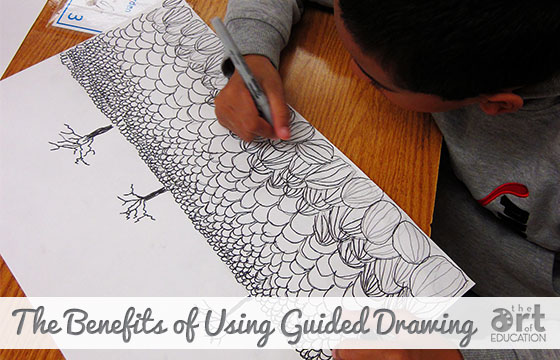
When I first started teaching, I never thought I would be the kind of teacher that would be in front of the room leading a step-by-step drawing. Boy, was I wrong! Guided drawing has become the cornerstone of much of my 2D teaching. With a lot of trial and error,  I have found just the right balance between those draw-along strategies and a more open-ended emphasis. There are a few things to keep in mind when finding the right balance for you in your classroom…

Using Guided Drawing

First, open-ended lessons are successful when students have some experience to draw from. Your littlest students need you to give them those tools before they can jump into the art deep end and feel ok about it. Once they’ve been guided through a few drawings, they can start to use what they’ve learned to make creations of their own. It feels so good when I see students using a trick or shape they learned in a previous lesson to create something new!

As your students get a little older, they may still crave the structure and success of a guided drawing or painting, but show signs of wanting to spread their wings. Oh, those classic middle children tendencies, you gotta love ‘em! This a great time to step your students through the beginning structure of a composition, then let them fill in the details from there. Drawing a portrait? Guide them through the shape of a head, then show them ten different ways to make each feature. Kind of like a “Choose Your Own Adventure” in the art room.
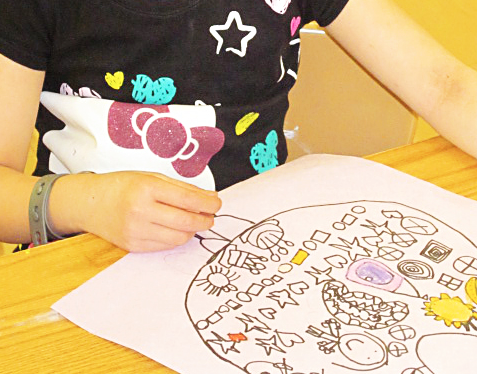
Guided Drawing

Finally, the big kids: my upper elementary students are my most self-conscious about their drawing abilities, and therefore I use a lot of the strategies that work with my youngest students. It sounds counterintuitive, but revisiting those tastes of success really works for us! For the older students, guided drawing lessons are great vehicles through which to teach any number of concepts or techniques. If they feel more comfortable in the drawing they’ve started with, there is a good chance they’ll feel more comfortable with risk-taking in other aspects of the work.

Guided drawing may start with teaching students the basics of “above”, “bigger”, or “draw a small oval”, but those directions can be very sturdy building blocks on which to build a solid and secure foundation of drawing knowledge and art confidence.

What are your favorite guided drawing techniques?

Do you prefer more open-ended lessons?

Related Posts Plugin for WordPress, Blogger...
Print Friendly

  • Vicky Siegel

    I totally agree with you. Lately, I have been showing visuals from my mimio/projector. For example, I had 10 different lion heads on the board (first graders were making warm colored lions). I could trace right on the white board as students recalled the lines and shapes they saw in the heads. Some students also came up to trace them. Then, as I was demonstrating at a table, we brainstormed how we could all make ours look different. They also each had a copy at their table of what we looked at on the projector. They were adorable and unique!

    • http://www.theartofed.com/ Sarah

      Vicky, I love the idea of using the projector at the white board and letting kiddoes draw there! Maybe if I learned more about my smart board we could use that too.

  • Charmaine Boggs

    I agree with you, Sarah, that all students can benefit from some guided instruction for drawing techniques. I sometimes use the lessons and ideas from the two books by Mona Brookes, Drawing with Children and Drawing for Older Children and Teens. I also use some of the how-to-draw picture ideas posted by Kathy Barbro on her Art Projects for Kids blog. I introduce them in first and second grade and after that I put them on the choice shelf for students who have a little extra time at the end of class. Students all the way through fifth grade like combining them to make up their own pictures, which are often quite humorous and creative.

    • http://www.theartofed.com/ Sarah

      How-to-draw activities are popular free-time choices with my students as well. I love when they employ those higher order thinking skills to synthesize their own ideas!

  • tmallett@yumaed.org

    Thanks Sarah! I just started doing this these past 2 years and the confidence in drawing has expanded. I do plan on using ideas from my most recent purchase of Mona Brookes book.

    • http://www.theartofed.com/ Sarah

      How rewarding when you can feel the results of your efforts paying off for you and your students!

  • Kathy

    I have been a big fan of guided drawing for years. I mostly use it to introduce a technique or for the youngest students to draw for example Clifford.
    But I have noticed something at my new building that has me a bit baffled. Maybe you can help. If I do a guided drawing of anything, lately it was Dr. Martin Luther King Jr. or cabins in perspective, that week they do awesome! But the next time they come to class, even if I review on camera at the beginning of the lesson, don’t get the same quality. A lot of the students like their first “practice” guided drawing better. And frankly they are better in some cases.

    Any thoughts on why this is? In 16 years of teaching don’t remember this ever being so obvious to me before. What’s they deal?

    • http://www.theartofed.com/ Sarah

      Kathy, when we practice in my classroom, we usually do it on a white board. Then, when the time comes to begin the finished product I step through everything all over again, essentially re-teaching the whole thing over again. Our finished lessons are rarely the assessment piece, so I can coach and re-teach as much as needed during that time. Why not make the practice your final piece? Then, employ some of the simple assessment practices we’ve covered on AOE to assess those skills. Hope this helps!