How to Assess Your Art Program is a two-part series covering an assessment process that will help you gain meaningful data to support your teaching and your art program! Read Part 1 below, and read Part 2 here.
At the end of each school year, how do you really know if your art program is effective? Are students learning what you intend? Is the curriculum you are teaching developmentally appropriate? Are students retaining important concepts?
If you can’t answer any of these questions, maybe it’s time you started to think about a program evaluation to assess your art program.
What is the difference between a program evaluation and a student progress assessment?
Program Evaluation
A program evaluation measures the overall curriculum and overall student performance knowledge. It helps the teacher drive their instruction, curriculum, and teaching strategies to improve the art program.
For example, if every year you’re finding your students don’t understand the concept of tints and shades in 2nd grade, it’s time to figure out why. Perhaps it’s not developmentally appropriate for a 2nd grader to be able to mix tints and shades. Or, perhaps you aren’t covering the topic as thoroughly as you could. A program evaluation can tell you all of these things and help you teach the concept more effectively or tweak your curriculum for the following year.
Student Progress Assessment
Student progress assessments, on the other hand, track individual student progress. Based on that individual data, a teacher can make changes or tweaks to the student’s educational plan. Individual student data is sent home to students and parents.
So, which is a better choice for the art room?
Because we see so many students each week, it would be nearly impossible to track individual student progress. For this reason, I strongly recommend a program evaluation for the art room. A program evaluation gives you meaningful data you can use and also validates your art program through data. In today’s day and age, we know if you don’t have data, you will fall behind.
In short, a program evaluation is a manageable solution to obtaining the data your administration craves. Plus, it also provides data you can use to inform your teaching without going through hours and hours of grading or individual monitoring.
Follow these simple steps to write an effective program evaluation for your entire art program or one of your art courses.
Step 1: Decide What to Assess
When writing a program evaluation, you first need to decide what the hallmarks of your art program are. To do this, list the 3-10 most important things that you want students to know after leaving your classroom.
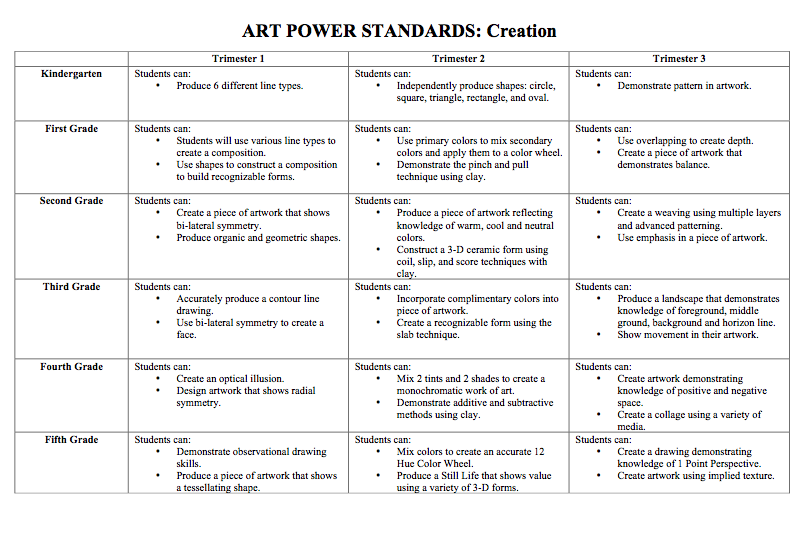
In my district, we have Power Standards that break down the most important concepts, making it easy for us to choose what we will assess. If you don’t have Power Standards, I highly suggest you write some to focus your work. Some call them learning outcomes or benchmarks, same thing! If you’d like to see an example of our Power Standards, you can click the image below to download the PDF.
Step 2: Decide How to Assess
The next step is choosing what type of assessment you want to use to assess the Power Standards. There is so much information in the Assessment in Art Education course that covers all of the different types of assessments you could create, so I will just keep it simple and tell you what our department decided to use.
We use a multi-tiered approach with small performance-based assessments, a few-fill-in-the-blanks, and some constructed responses. The bubble test of yore is long gone because it royally stank at truly assessing what our students were learning in the art room. We decided on a simple performance for each Power Standard that we teach.
Here is a sample below of what a simple performance might look like, broken up into 3 trimesters (all on one page, isn’t it handy?) This sample represents the 2nd grade Power Standards.
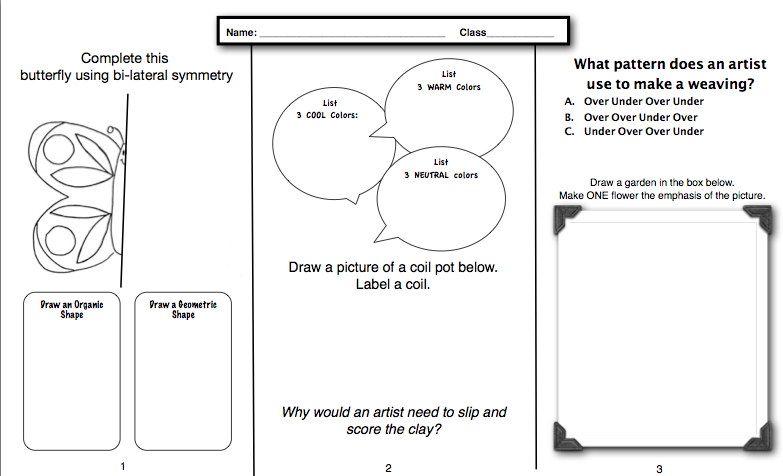
Do you see the 1, 2 and 3 at the bottom? These numbers represent each trimester. Students complete one section each trimester, and we have the data to record and store on one sheet of paper. We collect all the data from each trimester to get our final scores.
Now, you may be wondering why we don’t just use the students’ artwork or projects as assessments. Why create something additional? The answer is because, often, a teacher is helping a student along the way during a project. A true assessment should be the student independently performing the task.
Step 3: Decide When to Assess
Deciding when to give the assessment is an important factor. A few years ago, we were asked to give a bubble test in art at the end of the year. Yes, a whole year’s worth of content on one bubble test. The kids come once a week for 45 minutes. It just wasn’t fair. They couldn’t accurately remember what happened back in September. Not to mention, the assessment was about facts, not art performance. Now, we give our assessment at the end of every trimester term. There are just two questions, three times per school year. The assessment only takes 15 minutes and uses a simple checklist for grading (more on grading in Part 2). This way, the information is fresher in the students’ heads and paints a more accurate picture of what they learned that term.
Whew! That was a lot of information. I’ll just let you digest.
Stay tuned. In the next installment, we will cover how to grade the assessments, record your data, and use the data to both drive your art program and advocate for it!
Do you think a program evaluation would be helpful to you?
What questions do you have?
Magazine articles and podcasts are opinions of professional education contributors and do not necessarily represent the position of the Art of Education University (AOEU) or its academic offerings. Contributors use terms in the way they are most often talked about in the scope of their educational experiences.

 Article